Draw a Labelled Diagram of Neuron
| Neuron | |
|---|---|
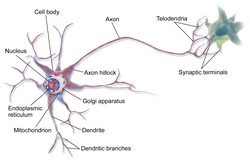 Anatomy of a multipolar neuron | |
| Identifiers | |
| MeSH | D009474 |
| NeuroLex ID | sao1417703748 |
| TA98 | A14.0.00.002 |
| TH | H2.00.06.1.00002 |
| FMA | 54527 |
| Anatomical terms of neuroanatomy [edit on Wikidata] | |
A neuron or nervus prison cell is an electrically excitable cell that communicates with other cells via specialized connections called synapses. The neuron is the main component of nervous tissue in all animals except sponges and placozoa. Plants and fungi do not have nervus cells.
Neurons are typically classified into 3 types based on their function. Sensory neurons answer to stimuli such every bit touch, audio, or light that touch the cells of the sensory organs, and they send signals to the spinal string or brain. Motor neurons receive signals from the brain and spinal cord to control everything from muscle contractions to glandular output. Interneurons connect neurons to other neurons within the same region of the brain or spinal string. When multiple neurons are connected together they form what is called a neural circuit.
A typical neuron consists of a cell torso (soma), dendrites, and a unmarried axon. The soma is a compact construction and the axon and dendrites are filaments extruding from the soma. Dendrites typically branch profusely and extend a few hundred micrometers from the soma. The axon leaves the soma at a swelling called the axon hillock and travels for as far as 1 meter in humans or more than in other species. It branches but unremarkably maintains a abiding bore. At the farthest tip of the axon's branches are axon terminals, where the neuron can transmit a signal across the synapse to some other cell. Neurons may lack dendrites or have no axon. The term neurite is used to describe either a dendrite or an axon, particularly when the jail cell is undifferentiated.
Most neurons receive signals via the dendrites and soma and transport out signals down the axon. At the bulk of synapses, signals cross from the axon of one neuron to a dendrite of another. However, synapses can connect an axon to another axon or a dendrite to another dendrite.
The signaling procedure is partly electric and partly chemical. Neurons are electrically excitable, due to maintenance of voltage gradients across their membranes. If the voltage changes by a large enough amount over a short interval, the neuron generates an all-or-goose egg electrochemical pulse called an action potential. This potential travels chop-chop forth the axon and activates synaptic connections as it reaches them. Synaptic signals may be excitatory or inhibitory, increasing or reducing the net voltage that reaches the soma.
In nearly cases, neurons are generated past neural stem cells during brain evolution and babyhood. Neurogenesis largely ceases during machismo in most areas of the brain.
Nervous system [edit]
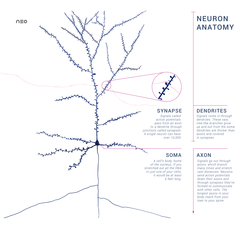
Schematic of an anatomically accurate unmarried pyramidal neuron, the primary excitatory neuron of cerebral cortex, with a synaptic connection from an incoming axon onto a dendritic spine.
Neurons are the primary components of the nervous system, forth with the glial cells that give them structural and metabolic back up. The nervous system is made up of the cardinal nervous arrangement, which includes the brain and spinal string, and the peripheral nervous system, which includes the autonomic and somatic nervous systems. In vertebrates, the majority of neurons belong to the key nervous organisation, only some reside in peripheral ganglia, and many sensory neurons are situated in sensory organs such every bit the retina and cochlea.
Axons may bundle into fascicles that brand up the fretfulness in the peripheral nervous organisation (like strands of wire make up cables). Bundles of axons in the primal nervous arrangement are chosen tracts.
Anatomy and histology [edit]

Diagram of the components of a neuron
Neurons are highly specialized for the processing and transmission of cellular signals. Given their diversity of functions performed in different parts of the nervous system, in that location is a wide diversity in their shape, size, and electrochemical backdrop. For instance, the soma of a neuron can vary from four to 100 micrometers in diameter.[1]
- The soma is the body of the neuron. As it contains the nucleus, about protein synthesis occurs here. The nucleus tin range from 3 to eighteen micrometers in diameter.[2]
- The dendrites of a neuron are cellular extensions with many branches. This overall shape and construction is referred to metaphorically as a dendritic tree. This is where the majority of input to the neuron occurs via the dendritic spine.
- The axon is a finer, cable-like projection that can extend tens, hundreds, or fifty-fifty tens of thousands of times the diameter of the soma in length. The axon primarily carries nerve signals away from the soma, and carries some types of information back to it. Many neurons accept simply 1 axon, only this axon may—and usually volition—undergo extensive branching, enabling advice with many target cells. The part of the axon where it emerges from the soma is chosen the axon hillock. Too being an anatomical structure, the axon hillock also has the greatest density of voltage-dependent sodium channels. This makes information technology the most easily excited part of the neuron and the spike initiation zone for the axon. In electrophysiological terms, information technology has the almost negative threshold potential.
- While the axon and axon hillock are generally involved in information outflow, this region can too receive input from other neurons.
- The axon last is found at the end of the axon farthest from the soma and contains synapses. Synaptic boutons are specialized structures where neurotransmitter chemicals are released to communicate with target neurons. In add-on to synaptic boutons at the axon terminal, a neuron may have en passant boutons, which are located along the length of the axon.
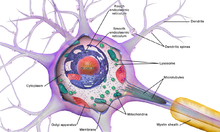
The accepted view of the neuron attributes dedicated functions to its various anatomical components; however, dendrites and axons often act in ways contrary to their then-called main function.[3]
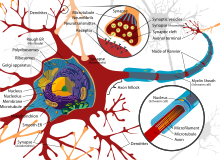
Diagram of a typical myelinated vertebrate motor neuron
Axons and dendrites in the central nervous organization are typically simply about i micrometer thick, while some in the peripheral nervous system are much thicker. The soma is normally about 10–25 micrometers in diameter and oft is not much larger than the cell nucleus it contains. The longest axon of a human motor neuron can be over a meter long, reaching from the base of the spine to the toes.
Sensory neurons can have axons that run from the toes to the posterior column of the spinal string, over 1.5 meters in adults. Giraffes take single axons several meters in length running forth the unabridged length of their necks. Much of what is known virtually axonal office comes from studying the squid giant axon, an ideal experimental grooming because of its relatively immense size (0.5–i millimeters thick, several centimeters long).
Fully differentiated neurons are permanently postmitotic[4] even so, stem cells nowadays in the adult brain may regenerate functional neurons throughout the life of an organism (run into neurogenesis). Astrocytes are star-shaped glial cells. They have been observed to turn into neurons by virtue of their stalk cell-like characteristic of pluripotency.
Membrane [edit]
Like all animal cells, the cell body of every neuron is enclosed past a plasma membrane, a bilayer of lipid molecules with many types of poly peptide structures embedded in it. A lipid bilayer is a powerful electrical insulator, but in neurons, many of the protein structures embedded in the membrane are electrically active. These include ion channels that let electrically charged ions to catamenia across the membrane and ion pumps that chemically ship ions from one side of the membrane to the other. Almost ion channels are permeable just to specific types of ions. Some ion channels are voltage gated, meaning that they can be switched between open and closed states by altering the voltage difference across the membrane. Others are chemically gated, pregnant that they can be switched betwixt open and airtight states by interactions with chemicals that diffuse through the extracellular fluid. The ion materials include sodium, potassium, chloride, and calcium. The interactions betwixt ion channels and ion pumps produce a voltage deviation beyond the membrane, typically a bit less than ane/x of a volt at baseline. This voltage has 2 functions: first, it provides a power source for an assortment of voltage-dependent protein machinery that is embedded in the membrane; second, it provides a ground for electrical signal manual between dissimilar parts of the membrane.
Histology and internal construction [edit]
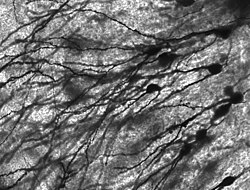
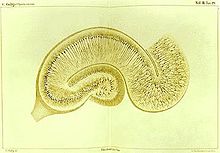
Golgi-stained neurons in human hippocampal tissue
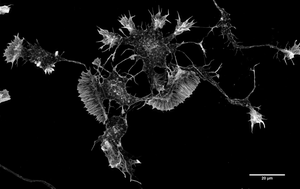
Actin filaments in a mouse cortical neuron in culture
Numerous microscopic clumps chosen Nissl bodies (or Nissl substance) are seen when nerve cell bodies are stained with a basophilic ("base-loving") dye. These structures consist of rough endoplasmic reticulum and associated ribosomal RNA. Named subsequently German psychiatrist and neuropathologist Franz Nissl (1860–1919), they are involved in protein synthesis and their prominence can be explained by the fact that nerve cells are very metabolically active. Basophilic dyes such every bit aniline or (weakly) haematoxylin[five] highlight negatively charged components, and and then bind to the phosphate backbone of the ribosomal RNA.
The cell body of a neuron is supported by a circuitous mesh of structural proteins chosen neurofilaments, which together with neurotubules (neuronal microtubules) are assembled into larger neurofibrils.[half dozen] Some neurons besides contain pigment granules, such as neuromelanin (a chocolate-brown-black pigment that is byproduct of synthesis of catecholamines), and lipofuscin (a yellow-dark-brown paint), both of which accumulate with historic period.[7] [viii] [nine] Other structural proteins that are of import for neuronal part are actin and the tubulin of microtubules. Class III β-tubulin is constitute almost exclusively in neurons. Actin is predominately establish at the tips of axons and dendrites during neuronal evolution. In that location the actin dynamics tin be modulated via an interplay with microtubule.[ten]
At that place are different internal structural characteristics between axons and dendrites. Typical axons well-nigh never contain ribosomes, except some in the initial segment. Dendrites contain granular endoplasmic reticulum or ribosomes, in diminishing amounts every bit the distance from the cell trunk increases.
Classification [edit]
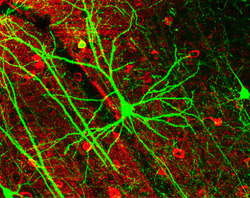
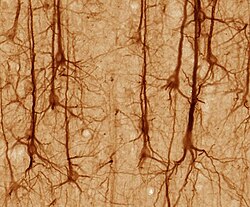
Neurons vary in shape and size and can be classified by their morphology and function.[12] The anatomist Camillo Golgi grouped neurons into two types; type I with long axons used to move signals over long distances and type II with short axons, which tin can often exist dislocated with dendrites. Blazon I cells can be further classified by the location of the soma. The basic morphology of type I neurons, represented by spinal motor neurons, consists of a cell body called the soma and a long thin axon covered by a myelin sheath. The dendritic tree wraps effectually the cell body and receives signals from other neurons. The terminate of the axon has branching axon terminals that release neurotransmitters into a gap called the synaptic crevice between the terminals and the dendrites of the next neuron.
Structural classification [edit]
Polarity [edit]
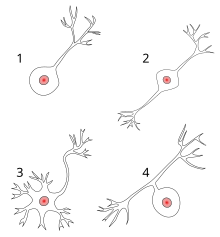
Most neurons can exist anatomically characterized as:
- Unipolar: unmarried process
- Bipolar: ane axon and 1 dendrite
- Multipolar: 1 axon and 2 or more than dendrites
- Golgi I: neurons with long-projecting axonal processes; examples are pyramidal cells, Purkinje cells, and anterior horn cells
- Golgi II: neurons whose axonal procedure projects locally; the best instance is the granule cell
- Anaxonic: where the axon cannot be distinguished from the dendrite(s)
- Pseudounipolar: 1 process which and so serves equally both an axon and a dendrite
Other [edit]
Some unique neuronal types tin can be identified according to their location in the nervous system and distinct shape. Some examples are:
- Basket cells, interneurons that form a dense plexus of terminals around the soma of target cells, found in the cortex and cerebellum
- Betz cells, large motor neurons
- Lugaro cells, interneurons of the cerebellum
- Medium spiny neurons, nigh neurons in the corpus striatum
- Purkinje cells, huge neurons in the cerebellum, a type of Golgi I multipolar neuron
- Pyramidal cells, neurons with triangular soma, a type of Golgi I
- Renshaw cells, neurons with both ends linked to blastoff motor neurons
- Unipolar brush cells, interneurons with unique dendrite ending in a brush-like tuft
- Granule cells, a blazon of Golgi Two neuron
- Anterior horn cells, motoneurons located in the spinal cord
- Spindle cells, interneurons that connect widely separated areas of the brain
Functional classification [edit]
Direction [edit]
- Afferent neurons convey information from tissues and organs into the primal nervous system and are too chosen sensory neurons.
- Efferent neurons (motor neurons) transmit signals from the cardinal nervous system to the effector cells.
- Interneurons connect neurons within specific regions of the key nervous organisation.
Afferent and efferent likewise refer generally to neurons that, respectively, bring information to or send data from the brain.
Action on other neurons [edit]
A neuron affects other neurons by releasing a neurotransmitter that binds to chemical receptors. The effect upon the postsynaptic neuron is determined by the blazon of receptor that is activated, not past the presynaptic neuron or past the neurotransmitter. A neurotransmitter can be thought of as a key, and a receptor as a lock: the same neurotransmitter can activate multiple types of receptors. Receptors tin be classified broadly as excitatory (causing an increase in firing charge per unit), inhibitory (causing a decrease in firing charge per unit), or modulatory (causing long-lasting furnishings not direct related to firing rate).
The two most common (90%+) neurotransmitters in the brain, glutamate and GABA, have largely consistent actions. Glutamate acts on several types of receptors, and has effects that are excitatory at ionotropic receptors and a modulatory event at metabotropic receptors. Similarly, GABA acts on several types of receptors, just all of them have inhibitory furnishings (in adult animals, at to the lowest degree). Because of this consistency, it is common for neuroscientists to refer to cells that release glutamate as "excitatory neurons", and cells that release GABA every bit "inhibitory neurons". Some other types of neurons have consistent effects, for instance, "excitatory" motor neurons in the spinal cord that release acetylcholine, and "inhibitory" spinal neurons that release glycine.
The distinction betwixt excitatory and inhibitory neurotransmitters is non absolute. Rather, it depends on the class of chemical receptors nowadays on the postsynaptic neuron. In principle, a unmarried neuron, releasing a single neurotransmitter, tin take excitatory effects on some targets, inhibitory effects on others, and modulatory furnishings on others notwithstanding. For example, photoreceptor cells in the retina constantly release the neurotransmitter glutamate in the absence of lite. So-chosen OFF bipolar cells are, similar most neurons, excited by the released glutamate. However, neighboring target neurons called ON bipolar cells are instead inhibited by glutamate, because they lack typical ionotropic glutamate receptors and instead express a class of inhibitory metabotropic glutamate receptors.[13] When low-cal is nowadays, the photoreceptors cease releasing glutamate, which relieves the ON bipolar cells from inhibition, activating them; this simultaneously removes the excitation from the OFF bipolar cells, silencing them.
It is possible to place the type of inhibitory effect a presynaptic neuron volition have on a postsynaptic neuron, based on the proteins the presynaptic neuron expresses. Parvalbumin-expressing neurons typically dampen the output signal of the postsynaptic neuron in the visual cortex, whereas somatostatin-expressing neurons typically block dendritic inputs to the postsynaptic neuron.[xiv]
Discharge patterns [edit]
Neurons have intrinsic electroresponsive properties like intrinsic transmembrane voltage oscillatory patterns.[xv] Then neurons tin can be classified according to their electrophysiological characteristics:
- Tonic or regular spiking. Some neurons are typically constantly (tonically) agile, typically firing at a abiding frequency. Example: interneurons in neurostriatum.
- Phasic or bursting. Neurons that burn down in bursts are called phasic.
- Fast spiking. Some neurons are notable for their high firing rates, for example some types of cortical inhibitory interneurons, cells in globus pallidus, retinal ganglion cells.[16] [17]
Neurotransmitter [edit]
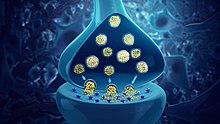
Synaptic vesicles containing neurotransmitters
Neurotransmitters are chemic messengers passed from one neuron to another neuron or to a muscle cell or gland cell.
- Cholinergic neurons – acetylcholine. Acetylcholine is released from presynaptic neurons into the synaptic cleft. It acts as a ligand for both ligand-gated ion channels and metabotropic (GPCRs) muscarinic receptors. Nicotinic receptors are pentameric ligand-gated ion channels equanimous of alpha and beta subunits that bind nicotine. Ligand bounden opens the channel causing influx of Na+ depolarization and increases the probability of presynaptic neurotransmitter release. Acetylcholine is synthesized from choline and acetyl coenzyme A.
- Adrenergic neurons – noradrenaline. Noradrenaline (norepinephrine) is released from nearly postganglionic neurons in the sympathetic nervous arrangement onto two sets of GPCRs: blastoff adrenoceptors and beta adrenoceptors. Noradrenaline is ane of the iii mutual catecholamine neurotransmitter, and the most prevalent of them in the peripheral nervous system; as with other catecholamines, information technology is synthesised from tyrosine.
- GABAergic neurons – gamma aminobutyric acid. GABA is one of 2 neuroinhibitors in the fundamental nervous system (CNS), along with glycine. GABA has a homologous function to ACh, gating anion channels that allow Cl− ions to enter the post synaptic neuron. Cl− causes hyperpolarization inside the neuron, decreasing the probability of an action potential firing equally the voltage becomes more negative (for an activity potential to fire, a positive voltage threshold must be reached). GABA is synthesized from glutamate neurotransmitters by the enzyme glutamate decarboxylase.
- Glutamatergic neurons – glutamate. Glutamate is one of two primary excitatory amino acid neurotransmitters, along with aspartate. Glutamate receptors are one of 4 categories, 3 of which are ligand-gated ion channels and 1 of which is a G-protein coupled receptor (ofttimes referred to as GPCR).
-
- AMPA and Kainate receptors role as cation channels permeable to Na+ cation channels mediating fast excitatory synaptic transmission.
- NMDA receptors are another cation channel that is more permeable to Ca2+. The part of NMDA receptors depend on glycine receptor binding equally a co-agonist within the channel pore. NMDA receptors do not function without both ligands nowadays.
- Metabotropic receptors, GPCRs attune synaptic transmission and postsynaptic excitability.
- Glutamate can crusade excitotoxicity when blood period to the encephalon is interrupted, resulting in brain damage. When blood flow is suppressed, glutamate is released from presynaptic neurons, causing greater NMDA and AMPA receptor activation than normal outside of stress weather condition, leading to elevated Ca2+ and Na+ entering the post synaptic neuron and prison cell damage. Glutamate is synthesized from the amino acrid glutamine by the enzyme glutamate synthase.
- Dopaminergic neurons—dopamine. Dopamine is a neurotransmitter that acts on D1 type (D1 and D5) Gs-coupled receptors, which increase campsite and PKA, and D2 type (D2, D3, and D4) receptors, which activate Gi-coupled receptors that decrease cAMP and PKA. Dopamine is connected to mood and beliefs and modulates both pre- and post-synaptic neurotransmission. Loss of dopamine neurons in the substantia nigra has been linked to Parkinson's disease. Dopamine is synthesized from the amino acid tyrosine. Tyrosine is catalyzed into levodopa (or L-DOPA) by tyrosine hydroxlase, and levadopa is and so converted into dopamine past the aromatic amino acid decarboxylase.
- Serotonergic neurons—serotonin. Serotonin (5-Hydroxytryptamine, v-HT) can act equally excitatory or inhibitory. Of its four 5-HT receptor classes, three are GPCR and 1 is a ligand-gated cation channel. Serotonin is synthesized from tryptophan past tryptophan hydroxylase, so further by decarboxylase. A lack of five-HT at postsynaptic neurons has been linked to depression. Drugs that block the presynaptic serotonin transporter are used for handling, such equally Prozac and Zoloft.
- Purinergic neurons—ATP. ATP is a neurotransmitter acting at both ligand-gated ion channels (P2X receptors) and GPCRs (P2Y) receptors. ATP is, however, best known as a cotransmitter. Such purinergic signalling can besides be mediated by other purines similar adenosine, which particularly acts at P2Y receptors.
- Histaminergic neurons—histamine. Histamine is a monoamine neurotransmitter and neuromodulator. Histamine-producing neurons are found in the tuberomammillary nucleus of the hypothalamus.[18] Histamine is involved in arousal and regulating sleep/wake behaviors.
Multimodel classification [edit]
Since 2012 there has been a push from the cellular and computational neuroscience community to come up up with a universal classification of neurons that will apply to all neurons in the brain as well every bit across species. This is done past considering the 3 essential qualities of all neurons: electrophysiology, morphology, and the individual transcriptome of the cells. Too being universal this classification has the advantage of being able to allocate astrocytes as well. A method called Patch-Seq in which all three qualities can be measured at once is used extensively by the Allen Institute for Brain Science.[19]
Connectivity [edit]
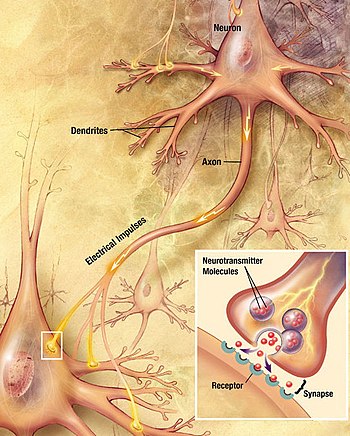
A betoken propagating downwardly an axon to the prison cell body and dendrites of the next cell
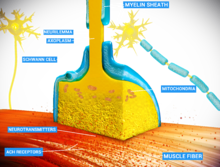
Neurons communicate with each other via synapses, where either the axon terminal of one cell contacts another neuron's dendrite, soma or, less normally, axon. Neurons such as Purkinje cells in the cerebellum tin take over 1000 dendritic branches, making connections with tens of thousands of other cells; other neurons, such equally the magnocellular neurons of the supraoptic nucleus, take only ane or two dendrites, each of which receives thousands of synapses.
Synapses can be excitatory or inhibitory, either increasing or decreasing action in the target neuron, respectively. Some neurons also communicate via electric synapses, which are direct, electrically conductive junctions betwixt cells.[20]
When an action potential reaches the axon concluding, it opens voltage-gated calcium channels, allowing calcium ions to enter the terminal. Calcium causes synaptic vesicles filled with neurotransmitter molecules to fuse with the membrane, releasing their contents into the synaptic cleft. The neurotransmitters diffuse across the synaptic cleft and actuate receptors on the postsynaptic neuron. Loftier cytosolic calcium in the axon terminal triggers mitochondrial calcium uptake, which, in turn, activates mitochondrial energy metabolism to produce ATP to support continuous neurotransmission.[21]
An autapse is a synapse in which a neuron's axon connects to its own dendrites.
The human brain has some eight.vi x tenten (fourscore vi billion) neurons.[22] Each neuron has on average 7,000 synaptic connections to other neurons. Information technology has been estimated that the brain of a three-year-old child has about 10xv synapses (i quadrillion). This number declines with historic period, stabilizing past adulthood. Estimates vary for an adult, ranging from 1014 to 5 x 10xiv synapses (100 to 500 trillion).[23]
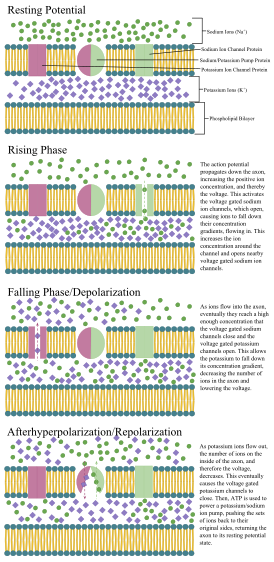
An annotated diagram of the stages of an action potential propagating down an axon including the role of ion concentration and pump and channel proteins.
Nonelectrochemical signaling [edit]
Across electrical and chemical signaling, studies suggest neurons in good for you human brains tin also communicate through:
- force generated by the enlargement of dendritic spines[24]
- the transfer of proteins – transneuronally transported proteins (TNTPs)[25] [26]
They can also go modulated by input from the surroundings and hormones released from other parts of the organism,[27] which could be influenced more than or less directly by neurons. This also applies to neurotrophins such equally BDNF. The gut microbiome is too connected with the brain.[28]
Mechanisms for propagating action potentials [edit]
In 1937 John Zachary Young suggested that the squid giant axon could be used to written report neuronal electrical properties.[29] Information technology is larger than but similar to human neurons, making it easier to study. By inserting electrodes into the squid giant axons, authentic measurements were made of the membrane potential.
The cell membrane of the axon and soma contain voltage-gated ion channels that allow the neuron to generate and propagate an electrical signal (an action potential). Some neurons also generate subthreshold membrane potential oscillations. These signals are generated and propagated by charge-carrying ions including sodium (Na+), potassium (1000+), chloride (Cl−), and calcium (Caii+).
Several stimuli can activate a neuron leading to electric activity, including pressure, stretch, chemical transmitters, and changes of the electric potential across the jail cell membrane.[30] Stimuli cause specific ion-channels within the prison cell membrane to open, leading to a flow of ions through the cell membrane, changing the membrane potential. Neurons must maintain the specific electrical properties that ascertain their neuron type.[31]
Thin neurons and axons crave less metabolic expense to produce and carry action potentials, merely thicker axons convey impulses more rapidly. To minimize metabolic expense while maintaining rapid conduction, many neurons accept insulating sheaths of myelin around their axons. The sheaths are formed by glial cells: oligodendrocytes in the key nervous organisation and Schwann cells in the peripheral nervous organization. The sheath enables action potentials to travel faster than in unmyelinated axons of the same bore, whilst using less energy. The myelin sheath in peripheral nerves normally runs along the axon in sections about 1 mm long, punctuated past unsheathed nodes of Ranvier, which contain a high density of voltage-gated ion channels. Multiple sclerosis is a neurological disorder that results from demyelination of axons in the cardinal nervous arrangement.
Some neurons exercise not generate action potentials, only instead generate a graded electrical signal, which in plough causes graded neurotransmitter release. Such non-spiking neurons tend to be sensory neurons or interneurons, because they cannot deport signals long distances.
Neural coding [edit]
Neural coding is concerned with how sensory and other information is represented in the encephalon by neurons. The main goal of studying neural coding is to characterize the relationship betwixt the stimulus and the individual or ensemble neuronal responses, and the relationships among the electrical activities of the neurons within the ensemble.[32] It is idea that neurons tin encode both digital and analog information.[33]
All-or-none principle [edit]
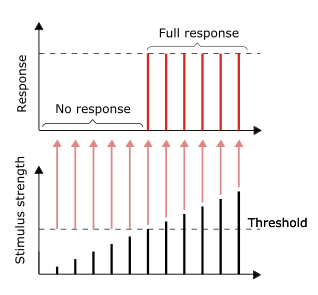
Equally long as the stimulus reaches the threshold, the full response would be given. Larger stimulus does not result in a larger response, vice versa.[34] : 31
The conduction of nerve impulses is an instance of an all-or-none response. In other words, if a neuron responds at all, then it must answer completely. Greater intensity of stimulation, like brighter image/louder sound, does not produce a stronger betoken, but can increase firing frequency.[34] : 31 Receptors respond in unlike ways to stimuli. Slowly adapting or tonic receptors respond to steady stimulus and produce a steady rate of firing. Tonic receptors well-nigh often respond to increased intensity of stimulus by increasing their firing frequency, usually as a power part of stimulus plotted against impulses per second. This tin be likened to an intrinsic belongings of lite where greater intensity of a specific frequency (color) requires more photons, as the photons can't become "stronger" for a specific frequency.
Other receptor types include quickly adapting or phasic receptors, where firing decreases or stops with steady stimulus; examples include skin which, when touched causes neurons to fire, only if the object maintains even force per unit area, the neurons terminate firing. The neurons of the skin and muscles that are responsive to force per unit area and vibration take filtering accessory structures that aid their part.
The pacinian corpuscle is 1 such structure. It has concentric layers like an onion, which form around the axon terminal. When pressure is applied and the corpuscle is deformed, mechanical stimulus is transferred to the axon, which fires. If the pressure is steady, stimulus ends; thus, typically these neurons respond with a transient depolarization during the initial deformation and again when the pressure level is removed, which causes the corpuscle to change shape again. Other types of adaptation are important in extending the function of a number of other neurons.[35]
Etymology and spelling [edit]
The German anatomist Heinrich Wilhelm Waldeyer introduced the term neuron in 1891,[36] based on the ancient Greek νεῦρον neuron 'sinew, cord, nervus'.[37]
The word was adopted in French with the spelling neurone. That spelling was as well used by many writers in English language,[38] merely has now become rare in American usage and uncommon in British usage.[39] [37]
History [edit]
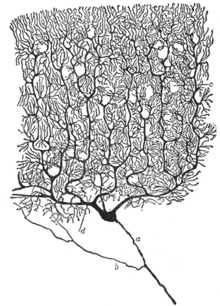
Drawing of a Purkinje cell in the cerebellar cortex done past Santiago Ramón y Cajal, demonstrating the ability of Golgi's staining method to reveal fine detail
The neuron's identify as the main functional unit of the nervous system was commencement recognized in the late 19th century through the piece of work of the Spanish anatomist Santiago Ramón y Cajal.[xl]
To make the structure of individual neurons visible, Ramón y Cajal improved a silvery staining procedure that had been developed by Camillo Golgi.[40] The improved process involves a technique called "double impregnation" and is all the same in utilise.
In 1888 Ramón y Cajal published a paper most the bird cerebellum. In this newspaper, he stated that he could not observe testify for anastomosis between axons and dendrites and called each nervous element "an absolutely autonomous canton."[40] [36] This became known as the neuron doctrine, one of the key tenets of modern neuroscience.[40]
In 1891, the German anatomist Heinrich Wilhelm Waldeyer wrote a highly influential review of the neuron doctrine in which he introduced the term neuron to describe the anatomical and physiological unit of the nervous system.[41] [42]
The silver impregnation stains are a useful method for neuroanatomical investigations because, for reasons unknown, information technology stains only a small percentage of cells in a tissue, exposing the consummate micro structure of individual neurons without much overlap from other cells.[43]
Neuron doctrine [edit]
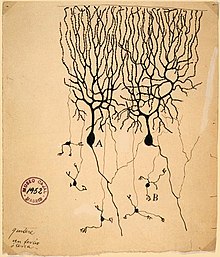
The neuron doctrine is the at present fundamental idea that neurons are the bones structural and functional units of the nervous organisation. The theory was put frontwards by Santiago Ramón y Cajal in the late 19th century. It held that neurons are discrete cells (not continued in a meshwork), acting as metabolically distinct units.
Later discoveries yielded refinements to the doctrine. For example, glial cells, which are not-neuronal, play an essential role in information processing.[44] Besides, electrical synapses are more common than previously idea,[45] comprising direct, cytoplasmic connections between neurons. In fact, neurons can form fifty-fifty tighter couplings: the squid giant axon arises from the fusion of multiple axons.[46]
Ramón y Cajal too postulated the Law of Dynamic Polarization, which states that a neuron receives signals at its dendrites and jail cell torso and transmits them, as action potentials, forth the axon in one direction: away from the prison cell body.[47] The Law of Dynamic Polarization has of import exceptions; dendrites tin serve every bit synaptic output sites of neurons[48] and axons can receive synaptic inputs.[49]
Compartmental modelling of neurons [edit]
Although neurons are often described of as "cardinal units" of the encephalon, they perform internal computations. Neurons integrate input within dendrites, and this complication is lost in models that presume neurons to exist a fundamental unit of measurement. Dendritic branches tin exist modeled as spatial compartments, whose activeness is related due to passive membrane properties, only may also be different depending on input from synapses. Compartmental modelling of dendrites is particularly helpful for understanding the beliefs of neurons that are likewise pocket-sized to tape with electrodes, equally is the case for Drosophila melanogaster.[50]
Neurons in the brain [edit]
The number of neurons in the brain varies dramatically from species to species.[51] In a human, there are an estimated ten–xx billion neurons in the cerebral cortex and 55–70 billion neurons in the cerebellum.[52] By contrast, the nematode worm Caenorhabditis elegans has just 302 neurons, making it an platonic model organism as scientists take been able to map all of its neurons. The fruit fly Drosophila melanogaster, a common subject in biological experiments, has effectually 100,000 neurons and exhibits many complex behaviors. Many backdrop of neurons, from the type of neurotransmitters used to ion channel composition, are maintained across species, allowing scientists to report processes occurring in more complex organisms in much simpler experimental systems.
Neurological disorders [edit]
Charcot–Marie–Tooth disease (CMT) is a heterogeneous inherited disorder of nerves (neuropathy) that is characterized by loss of muscle tissue and bear on sensation, predominantly in the feet and legs extending to the easily and arms in advanced stages. Presently incurable, this illness is i of the virtually common inherited neurological disorders, with 36 in 100,000 affected.[53]
Alzheimer's affliction (AD), also known but equally Alzheimer'southward, is a neurodegenerative disease characterized by progressive cognitive deterioration, together with declining activities of daily living and neuropsychiatric symptoms or behavioral changes.[54] The most hitting early symptom is loss of brusque-term retentiveness (amnesia), which usually manifests as modest forgetfulness that becomes steadily more than pronounced with illness progression, with relative preservation of older memories. As the disorder progresses, cerebral (intellectual) damage extends to the domains of linguistic communication (aphasia), skilled movements (apraxia), and recognition (agnosia), and functions such as decision-making and planning get impaired.[55] [56]
Parkinson'south disease (PD), also known as Parkinson illness, is a degenerative disorder of the key nervous organization that often impairs motor skills and speech.[57] Parkinson'southward illness belongs to a group of atmospheric condition called movement disorders.[58] It is characterized past muscle rigidity, tremor, a slowing of physical movement (bradykinesia), and in extreme cases, a loss of physical movement (akinesia). The primary symptoms are the results of decreased stimulation of the motor cortex by the basal ganglia, normally caused by the insufficient formation and action of dopamine, which is produced in the dopaminergic neurons of the brain. Secondary symptoms may include high level cognitive dysfunction and subtle linguistic communication problems. PD is both chronic and progressive.
Myasthenia gravis is a neuromuscular disease leading to fluctuating muscle weakness and fatigability during simple activities. Weakness is typically acquired by circulating antibodies that block acetylcholine receptors at the post-synaptic neuromuscular junction, inhibiting the stimulative upshot of the neurotransmitter acetylcholine. Myasthenia is treated with immunosuppressants, cholinesterase inhibitors and, in selected cases, thymectomy.
Demyelination [edit]

Guillain–Barré syndrome – demyelination
Demyelination is the human activity of demyelinating, or the loss of the myelin sheath insulating the fretfulness. When myelin degrades, conduction of signals along the nervus can be dumb or lost, and the nerve eventually withers. This leads to certain neurodegenerative disorders like multiple sclerosis and chronic inflammatory demyelinating polyneuropathy.
Axonal degeneration [edit]
Although most injury responses include a calcium influx signaling to promote resealing of severed parts, axonal injuries initially lead to acute axonal degeneration, which is the rapid separation of the proximal and distal ends, occurring within xxx minutes of injury. Degeneration follows with swelling of the axolemma, and eventually leads to dewdrop-like formation. Granular disintegration of the axonal cytoskeleton and inner organelles occurs subsequently axolemma degradation. Early changes include accumulation of mitochondria in the paranodal regions at the site of injury. Endoplasmic reticulum degrades and mitochondria swell up and somewhen disintegrate. The disintegration is dependent on ubiquitin and calpain proteases (caused by the influx of calcium ion), suggesting that axonal degeneration is an active process that produces complete fragmentation. The process takes about roughly 24 hours in the PNS and longer in the CNS. The signaling pathways leading to axolemma degeneration are unknown.
Neurogenesis [edit]
Neurons are born through the process of neurogenesis, in which neural stem cells divide to produce differentiated neurons. Once fully differentiated neurons are formed, they are no longer capable of undergoing mitosis. Neurogenesis primarily occurs in the embryo of well-nigh organisms.
Adult neurogenesis can occur and studies of the historic period of human neurons advise that this procedure occurs only for a minority of cells, and that the vast bulk of neurons in the neocortex forms before nativity and persists without replacement. The extent to which adult neurogenesis exists in humans, and its contribution to cognition are controversial, with conflicting reports published in 2018.[59]
The body contains a variety of stem prison cell types that have the capacity to differentiate into neurons. Researchers found a way to transform human pare cells into nerve cells using transdifferentiation, in which "cells are forced to adopt new identities".[60]
During neurogenesis in the mammalian brain, progenitor and stalk cells progress from proliferative divisions to differentiative divisions. This progression leads to the neurons and glia that populate cortical layers. Epigenetic modifications play a fundamental role in regulating gene expression in differentiating neural stem cells, and are critical for cell fate determination in the developing and adult mammalian encephalon. Epigenetic modifications include Deoxyribonucleic acid cytosine methylation to course five-methylcytosine and v-methylcytosine demethylation.[61] These modifications are disquisitional for cell fate determination in the developing and adult mammalian brain. Deoxyribonucleic acid cytosine methylation is catalyzed by Deoxyribonucleic acid methyltransferases (DNMTs). Methylcytosine demethylation is catalyzed in several stages by TET enzymes that carry out oxidative reactions (east.g. 5-methylcytosine to 5-hydroxymethylcytosine) and enzymes of the Dna base of operations excision repair (BER) pathway.[61]
At different stages of mammalian nervous system development ii Dna repair processes are employed in the repair of Deoxyribonucleic acid double-strand breaks. These pathways are homologous recombinational repair used in proliferating neural precursor cells, and not-homologous end joining used mainly at after developmental stages[62]
Nerve regeneration [edit]
Peripheral axons can regrow if they are severed,[63] but one neuron cannot be functionally replaced past ane of another type (Llinás' law).[15]
Come across also [edit]
- Artificial neuron
- Bidirectional cell
- Biological neuron model
- Compartmental neuron models
- Connectome
- Dogiel cell
- List of animals by number of neurons
- List of neuroscience databases
- Neuronal galvanotropism
- Neuroplasticity
- Growth cone
- Sholl analysis
References [edit]
- ^ Davies, Melissa (2002-04-09). "The Neuron: size comparison". Neuroscience: A journeying through the brain . Retrieved 2009-06-20 .
- ^ Chudler EH. "Brain Facts and Figures". Neuroscience for Kids . Retrieved 2009-06-20 .
- ^ "16.7: Nervous Organization". Biology LibreTexts. 2021-01-fourteen. Retrieved 2022-02-28 .
- ^ Herrup One thousand, Yang Y (May 2007). "Cell cycle regulation in the postmitotic neuron: oxymoron or new biology?". Nature Reviews. Neuroscience. 8 (v): 368–78. doi:10.1038/nrn2124. PMID 17453017. S2CID 12908713.
- ^ State Hospitals Bulletin. Land Commission in Lunacy. 1897. p. 378.
- ^ "Medical Definition of Neurotubules". world wide web.merriam-webster.com.
- ^ Zecca L, Gallorini Thou, Schünemann V, Trautwein AX, Gerlach One thousand, Riederer P, Vezzoni P, Tampellini D (March 2001). "Iron, neuromelanin and ferritin content in the substantia nigra of normal subjects at different ages: consequences for iron storage and neurodegenerative processes". Journal of Neurochemistry. 76 (6): 1766–73. doi:x.1046/j.1471-4159.2001.00186.x. PMID 11259494. S2CID 31301135.
- ^ Herrero MT, Hirsch EC, Kastner A, Luquin MR, Javoy-Agid F, Gonzalo LM, Obeso JA, Agid Y (1993). "Neuromelanin accumulation with age in catecholaminergic neurons from Macaca fascicularis brainstem". Developmental Neuroscience. 15 (1): 37–48. doi:x.1159/000111315. PMID 7505739.
- ^ Brunk UT, Terman A (September 2002). "Lipofuscin: mechanisms of age-related accumulation and influence on cell function". Complimentary Radical Biology & Medicine. 33 (v): 611–nine. doi:10.1016/s0891-5849(02)00959-0. PMID 12208347.
- ^ Zhao B, Meka DP, Scharrenberg R, König T, Schwanke B, Kobler O, Windhorst South, Kreutz MR, Mikhaylova M, Calderon de Anda F (August 2017). "Microtubules Modulate F-actin Dynamics during Neuronal Polarization". Scientific Reports. seven (1): 9583. Bibcode:2017NatSR...7.9583Z. doi:10.1038/s41598-017-09832-8. PMC5575062. PMID 28851982.
- ^ Lee WC, Huang H, Feng G, Sanes JR, Brownish EN, Then PT, Nedivi E (February 2006). "Dynamic remodeling of dendritic arbors in GABAergic interneurons of adult visual cortex". PLOS Biology. 4 (2): e29. doi:10.1371/journal.pbio.0040029. PMC1318477. PMID 16366735.
- ^ Al, Martini, Frederic Et. Anatomy and Physiology' 2007 Ed.2007 Edition. Rex Bookstore, Inc. p. 288. ISBN978-971-23-4807-5.
- ^ Gerber U (January 2003). "Metabotropic glutamate receptors in vertebrate retina". Documenta Ophthalmologica. Advances in Ophthalmology. 106 (i): 83–seven. doi:10.1023/A:1022477203420. PMID 12675489. S2CID 22296630.
- ^ Wilson NR, Runyan CA, Wang FL, Sur M (Baronial 2012). "Division and subtraction past distinct cortical inhibitory networks in vivo". Nature. 488 (7411): 343–8. Bibcode:2012Natur.488..343W. doi:10.1038/nature11347. hdl:1721.1/92709. PMC3653570. PMID 22878717.
- ^ a b Llinás RR (2014-01-01). "Intrinsic electrical properties of mammalian neurons and CNS function: a historical perspective". Frontiers in Cellular Neuroscience. viii: 320. doi:10.3389/fncel.2014.00320. PMC4219458. PMID 25408634.
- ^ Kolodin YO, Veselovskaia NN, Veselovsky NS, Fedulova SA. Ion conductances related to shaping the repetitive firing in rat retinal ganglion cells. Acta Physiologica Congress. Archived from the original on 2012-10-07. Retrieved 2009-06-20 .
- ^ "Ionic conductances underlying excitability in tonically firing retinal ganglion cells of adult rat". Ykolodin.50webs.com. 2008-04-27. Retrieved 2013-02-16 .
- ^ Scammell TE, Jackson Air conditioning, Franks NP, Wisden Due west, Dauvilliers Y (January 2019). "Histamine: neural circuits and new medications". Sleep. 42 (1). doi:10.1093/sleep/zsy183. PMC6335869. PMID 30239935.
- ^ "Patch-seq technique helps depict the variation of neural cells in the brain". News-medical.net. three December 2020. Retrieved 26 August 2021.
{{cite spider web}}: CS1 maint: url-status (link) - ^ Macpherson, Gordon (2002). Black'south Medical Lexicon (40 ed.). Lanham, Physician: Scarecrow Press. pp. 431–434. ISBN0810849844.
- ^ Ivannikov MV, Macleod GT (June 2013). "Mitochondrial free Ca²⁺ levels and their furnishings on energy metabolism in Drosophila motor nervus terminals". Biophysical Journal. 104 (11): 2353–61. Bibcode:2013BpJ...104.2353I. doi:ten.1016/j.bpj.2013.03.064. PMC3672877. PMID 23746507.
- ^ Herculano-Houzel S (November 2009). "The human brain in numbers: a linearly scaled-upward primate brain". Frontiers in Man Neuroscience. 3: 31. doi:10.3389/neuro.09.031.2009. PMC2776484. PMID 19915731.
- ^ Drachman DA (June 2005). "Do we have brain to spare?". Neurology. 64 (12): 2004–v. doi:x.1212/01.WNL.0000166914.38327.BB. PMID 15985565. S2CID 38482114.
- ^ Ucar, Hasan; Watanabe, Satoshi; Noguchi, Jun; Morimoto, Yuichi; Iino, Yusuke; Yagishita, Sho; Takahashi, Noriko; Kasai, Haruo (December 2021). "Mechanical deportment of dendritic-spine enlargement on presynaptic exocytosis". Nature. 600 (7890): 686–689. doi:ten.1038/s41586-021-04125-7. ISSN 1476-4687.
Lay summary:
"Forceful synapses reveal mechanical interactions in the brain". Nature. 24 November 2021. doi:10.1038/d41586-021-03516-0. Retrieved 21 Feb 2022. - ^ "Researchers discover new type of cellular communication in the brain". The Scripps Inquiry Found . Retrieved 12 Feb 2022.
- ^ Schiapparelli, Lucio Thou.; Sharma, Pranav; He, Hai-Yan; Li, Jianli; Shah, Sahil H.; McClatchy, Daniel B.; Ma, Yuanhui; Liu, Han-Hsuan; Goldberg, Jeffrey Fifty.; Yates, John R.; Cline, Hollis T. (25 January 2022). "Proteomic screen reveals diverse poly peptide transport between connected neurons in the visual system". Prison cell Reports. 38 (4). doi:10.1016/j.celrep.2021.110287. ISSN 2211-1247.
- ^ Levitan, Irwin B.; Kaczmarek, Leonard K. "Electrical Signaling in Neurons". Oxford Academy Printing. doi:10.1093/med/9780199773893.001.0001/med-9780199773893-chapter-3.
- ^ O'Leary, Olivia F.; Ogbonnaya, Ebere S.; Felice, Daniela; Levone, Brunno R.; C. Conroy, Lorraine; Fitzgerald, Patrick; Bravo, Javier A.; Forsythe, Paul; Bienenstock, John; Dinan, Timothy G.; Cryan, John F. (1 Feb 2018). "The vagus nerve modulates BDNF expression and neurogenesis in the hippocampus". European Neuropsychopharmacology. 28 (2): 307–316. doi:10.1016/j.euroneuro.2017.12.004. ISSN 0924-977X.
- ^ Chudler EH. "Milestones in Neuroscience Research". Neuroscience for Kids . Retrieved 2009-06-twenty .
- ^ Patlak J, Gibbons R (2000-xi-01). "Electrical Activity of Nerves". Activeness Potentials in Nervus Cells. Archived from the original on August 27, 2009. Retrieved 2009-06-20 .
- ^ Harris-Warrick, RM (October 2011). "Neuromodulation and flexibility in Cardinal Blueprint Generator networks". Electric current Opinion in Neurobiology. 21 (five): 685–92. doi:10.1016/j.conb.2011.05.011. PMC3171584. PMID 21646013.
- ^ Brown EN, Kass RE, Mitra PP (May 2004). "Multiple neural fasten train data analysis: state-of-the-art and time to come challenges". Nature Neuroscience. 7 (5): 456–61. doi:ten.1038/nn1228. PMID 15114358. S2CID 562815.
- ^ Thorpe SJ (1990). "Fasten arrival times: A highly efficient coding scheme for neural networks" (PDF). In Eckmiller R, Hartmann Thousand, Hauske Chiliad (eds.). Parallel processing in neural systems and computers. Due north-Holland. pp. 91–94. ISBN9780444883902. Archived from the original (PDF) on 2012-02-fifteen.
- ^ a b Kalat, James West (2016). Biological psychology (12 ed.). Australia. ISBN9781305105409. OCLC 898154491.
- ^ Eckert R, Randall D (1983). Animal physiology: mechanisms and adaptations. San Francisco: W.H. Freeman. p. 239. ISBN978-0-7167-1423-one.
- ^ a b Finger, Stanley (1994). Origins of neuroscience : a history of explorations into brain function. Oxford University Press. p. 47. ISBN9780195146943. OCLC 27151391.
Ramon y Cajal'due south showtime paper on the Golgi stain was on the bird cerebellum, and it appeared in the Revista in 1888. He acknowledged that he found the nerve fibers to be very intricate, but stated that he could find no evidence for either axons or dendrites undergoing anastomosis and forming nets. He called each nervous element 'an absolutely autonomous canton.'
- ^ a b Oxford English Lexicon, 3rd edition, 2003, south.v.
- ^ Mehta AR, Mehta PR, Anderson SP, MacKinnon BL, Compston A (Jan 2020). "Grayness Thing Etymology and the neuron(e)". Brain. 143 (1): 374–379. doi:ten.1093/encephalon/awz367. PMC6935745. PMID 31844876.
- ^ "Google Books Ngram Viewer". books.google.com . Retrieved nineteen December 2020.
- ^ a b c d López-Muñoz F, Boya J, Alamo C (October 2006). "Neuron theory, the cornerstone of neuroscience, on the centenary of the Nobel Prize honor to Santiago Ramón y Cajal". Brain Research Message. 70 (4–half-dozen): 391–405. doi:10.1016/j.brainresbull.2006.07.010. PMID 17027775. S2CID 11273256.
- ^ Finger, Stanley (1994). Origins of neuroscience : a history of explorations into brain role. Oxford University Press. p. 47. ISBN9780195146943. OCLC 27151391.
... a man who would write a highly influential review of the evidence in favor of the neuron doctrine 2 years after. In his paper, Waldeyer (1891), ... , wrote that nerve cells finish freely with end arborizations and that the 'neuron' is the anatomical and physiological unit of the nervous system. The word 'neuron' was born this style.
- ^ "Whonamedit - dictionary of medical eponyms". www.whonamedit.com.
Today, Wilhelm von Waldeyer-Hartz is remembered equally the founder of the neurone theory, coining the term "neurone" to draw the cellular office unit of the nervous organisation and enunciating and clarifying that concept in 1891.
- ^ Grant M (October 2007). "How the 1906 Nobel Prize in Physiology or Medicine was shared between Golgi and Cajal". Brain Research Reviews. 55 (ii): 490–viii. doi:10.1016/j.brainresrev.2006.eleven.004. PMID 17306375. S2CID 24331507.
- ^ Witcher MR, Kirov SA, Harris KM (January 2007). "Plasticity of perisynaptic astroglia during synaptogenesis in the mature rat hippocampus". Glia. 55 (1): thirteen–23. CiteSeerXten.1.1.598.7002. doi:x.1002/glia.20415. PMID 17001633. S2CID 10664003.
- ^ Connors BW, Long MA (2004). "Electrical synapses in the mammalian brain". Annual Review of Neuroscience. 27 (1): 393–418. doi:10.1146/annurev.neuro.26.041002.131128. PMID 15217338.
- ^ Guillery RW (June 2005). "Observations of synaptic structures: origins of the neuron doctrine and its current status". Philosophical Transactions of the Royal Society of London. Series B, Biological Sciences. 360 (1458): 1281–307. doi:ten.1098/rstb.2003.1459. PMC1569502. PMID 16147523.
- ^ Sabbatini RM (Apr–July 2003). "Neurons and Synapses: The History of Its Discovery". Brain & Mind Magazine: 17.
- ^ Djurisic Grand, Antic S, Chen WR, Zecevic D (July 2004). "Voltage imaging from dendrites of mitral cells: EPSP attenuation and spike trigger zones". The Journal of Neuroscience. 24 (30): 6703–14. doi:10.1523/JNEUROSCI.0307-04.2004. hdl:1912/2958. PMC6729725. PMID 15282273.
- ^ Cochilla AJ, Alford Due south (March 1997). "Glutamate receptor-mediated synaptic excitation in axons of the lamprey". The Journal of Physiology. 499 (Pt ii): 443–57. doi:10.1113/jphysiol.1997.sp021940. PMC1159318. PMID 9080373.
- ^ Gouwens NW, Wilson RI (2009). "Signal propagation in Drosophila central neurons". Journal of Neuroscience. 29 (xix): 6239–6249. doi:10.1523/jneurosci.0764-09.2009. PMC2709801. PMID 19439602.
- ^ Williams RW, Herrup Yard (1988). "The command of neuron number". Annual Review of Neuroscience. eleven (1): 423–53. doi:10.1146/annurev.ne.11.030188.002231. PMID 3284447.
- ^ von Bartheld CS, Bahney J, Herculano-Houzel South (December 2016). "The search for true numbers of neurons and glial cells in the human being brain: A review of 150 years of prison cell counting". The Journal of Comparative Neurology. 524 (18): 3865–3895. doi:10.1002/cne.24040. PMC5063692. PMID 27187682.
- ^ Krajewski KM, Lewis RA, Fuerst DR, Turansky C, Hinderer SR, Garbern J, Kamholz J, Shy ME (July 2000). "Neurological dysfunction and axonal degeneration in Charcot-Marie-Tooth disease blazon 1A". Brain. 123 (7): 1516–27. doi:10.1093/brain/123.7.1516. PMID 10869062.
- ^ "Virtually Alzheimer'due south Illness: Symptoms". National Institute on Aging. Archived from the original on 15 January 2012. Retrieved 28 December 2011.
- ^ Burns A, Iliffe South (February 2009). "Alzheimer's disease". BMJ. 338: b158. doi:10.1136/bmj.b158. PMID 19196745. S2CID 8570146.
- ^ Querfurth HW, LaFerla FM (January 2010). "Alzheimer'due south affliction". The New England Journal of Medicine. 362 (4): 329–44. doi:x.1056/NEJMra0909142. PMID 20107219. S2CID 205115756.
- ^ "Parkinson'due south Disease Information Page". NINDS. xxx June 2016. Archived from the original on 4 January 2017. Retrieved 18 July 2016.
- ^ "Motion Disorders". The International Neuromodulation Society.
- ^ Kempermann Thou, Gage FH, Aigner L, Song H, Curtis MA, Thuret S, Kuhn HG, Jessberger South, Frankland Pw, Cameron HA, Gould E, Hen R, Abrous DN, Toni Due north, Schinder AF, Zhao X, Lucassen PJ, Frisén J (July 2018). "Human Adult Neurogenesis: Evidence and Remaining Questions". Cell Stalk Jail cell. 23 (one): 25–thirty. doi:10.1016/j.stem.2018.04.004. PMC6035081. PMID 29681514.
- ^ Callaway, Ewen (26 May 2011). "How to make a human neuron". Nature. doi:x.1038/news.2011.328.
By transforming cells from human skin into working nerve cells, researchers may have come up up with a model for nervous-system diseases and mayhap even regenerative therapies based on cell transplants. The accomplishment, reported online today in Nature, is the latest in a fast-moving field called transdifferentiation, in which cells are forced to adopt new identities. In the past twelvemonth, researchers accept converted connective tissue cells found in pare into heart cells, blood cells, and liver cells.
- ^ a b Wang Z, Tang B, He Y, Jin P (March 2016). "DNA methylation dynamics in neurogenesis". Epigenomics. 8 (3): 401–14. doi:ten.2217/epi.15.119. PMC4864063. PMID 26950681.
- ^ Orii KE, Lee Y, Kondo Northward, McKinnon PJ (June 2006). "Selective utilization of nonhomologous end-joining and homologous recombination DNA repair pathways during nervous system development". Proceedings of the National Academy of Sciences of the United States of America. 103 (26): 10017–22. Bibcode:2006PNAS..10310017O. doi:10.1073/pnas.0602436103. PMC1502498. PMID 16777961.
- ^ Yiu Yard, He Z (August 2006). "Glial inhibition of CNS axon regeneration". Nature Reviews. Neuroscience. 7 (8): 617–27. doi:10.1038/nrn1956. PMC2693386. PMID 16858390.
Further reading [edit]
- Bullock Thursday, Bennett MV, Johnston D, Josephson R, Marder E, Fields RD (November 2005). "Neuroscience. The neuron doctrine, redux". Scientific discipline. 310 (5749): 791–3. doi:10.1126/scientific discipline.1114394. PMID 16272104. S2CID 170670241.
- Kandel ER, Schwartz JH, Jessell TM (2000). Principles of Neural Science (4th ed.). New York: McGraw-Loma. ISBN0-8385-7701-half dozen.
- Peters A, Palay SL, Webster HS (1991). The Fine Structure of the Nervous System (3rd ed.). New York: Oxford University Printing. ISBN0-19-506571-nine.
- Ramón y Cajal South (1933). Histology (tenth ed.). Baltimore: Wood.
- Roberts A, Bush-league BM (1981). Neurones without Impulses. Cambridge: Cambridge University Press. ISBN0-521-29935-seven.
- Snell RS (2010). Clinical Neuroanatomy. Lippincott Williams & Wilkins. ISBN978-0-7817-9427-5.
External links [edit]
- Neurobiology at Curlie
- IBRO (International Brain Research System). Fostering neuroscience research especially in less well-funded countries.
- NeuronBank an online neuromics tool for cataloging neuronal types and synaptic connectivity.
- High Resolution Neuroanatomical Images of Primate and Not-Primate Brains.
- The Department of Neuroscience at Wikiversity, which presently offers two courses: Fundamentals of Neuroscience and Comparative Neuroscience.
- NIF Search – Neuron via the Neuroscience Information Framework
- Cell Centered Database – Neuron
- Complete list of neuron types according to the Petilla convention, at NeuroLex.
- NeuroMorpho.Org an online database of digital reconstructions of neuronal morphology.
- Immunohistochemistry Image Gallery: Neuron
- Khan Academy: Anatomy of a neuron
- Neuron images
dreyerfittleand1995.blogspot.com
Source: https://en.wikipedia.org/wiki/Neuron
0 Response to "Draw a Labelled Diagram of Neuron"
Postar um comentário